
In this section ▾
Planters, irrigation and planting
Planters, soil, drip irrigation, misting and plants: everything that makes a green wall grow, planned with the structure.
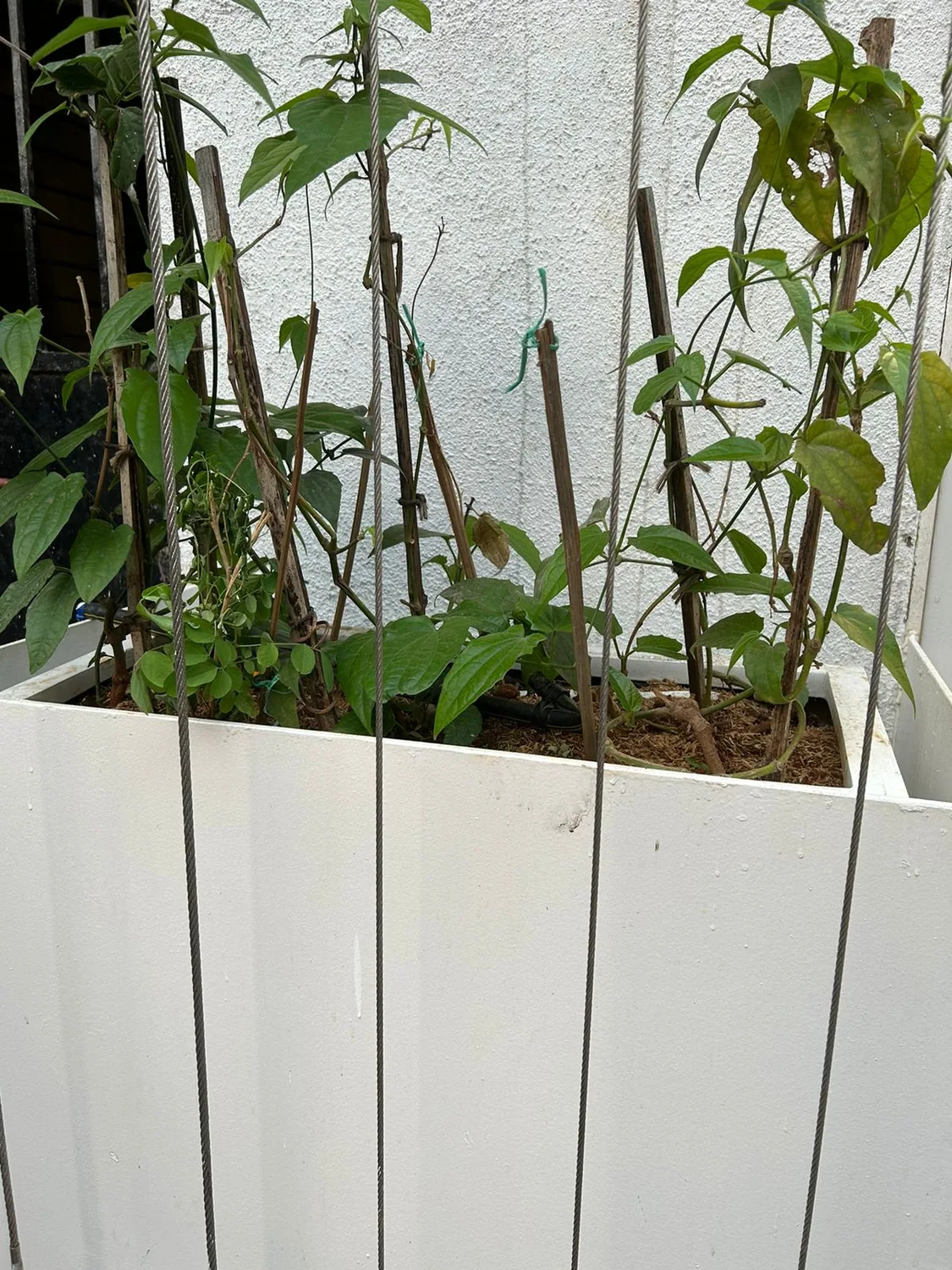 Acier project
OverviewWhat it is
Plants grow as well as their roots allow. We size planters to the plants and the wall, fill them with a lightweight growing mix, drain them into a collector pipe, water them with pressure-compensating drip on a timer, and choose species for the city, the sun and the wind.
Ground-level beds grow best of all. Where the wall is tall, planters every floor let each climber cover about one storey, and trailing plants hang down from the level above, so the wall knits together in about a year to 18 months.
Options
Plan itPlan your green wall
Planner
Technical dataSizes and figures
Loads per metre of planter (for the structural check)
| Item | Lightweight mix | Garden soil |
|---|---|---|
| Media in a 1000 × 400 × 450 module | about 180 kg | about 300 kg |
| Planter (FRP to steel) | 20 to 40 kg | 20 to 40 kg |
| Plants and water | 15 to 25 kg | 15 to 25 kg |
| Total per metre, wet | 215 to 245 kg | 335 to 365 kg |
GrowthHow fast will it be green?
With fast climbers, planters at every floor (or beds at ground level) and automatic drip irrigation, a green façade is typically fully dense in 12 to 18 months. Planters every second floor, slower flowering species or a harsh west face can take up to 2 to 3 years.
Planting in the ground always grows fastest: roots spread freely, the soil keeps them cool and moist, and a missed watering day does no harm. Where the site allows, we plant at ground level and add planters at every floor or two to carry the green up the building.
Spacing between planter levels
| Planter levels | Best for | Dense cover (typical) |
|---|---|---|
| Every floor, about 3.2 m | Fastest, densest result; climbers and trailers in every planter | 12 to 18 months |
| Every second floor, about 6.4 m | Fewer planters; fast twiners plus a trailing edge | 18 to 30 months |
| Ground beds only | Walls and buildings up to about 12 m | 12 to 24 months to 6 to 8 m |
- Climbers grow up 3 to 6 m from a planter; trailers hang down 1.5 to 3 m. A pair of planters covers the height between them.
- Give each plant at least 40 to 60 L of growing media, and at least 40 L per m² of wall a planter is meant to cover.
- Plant pre-monsoon (May to July), use 1 to 1.5 m nursery plants, tie in new shoots every 2 to 4 weeks, and pinch the tips at 1 m and 2 m to make them bush out.
PlantsClimbers that work in India
Growth with good care: drip irrigation, feeding and enough root volume
| Plant | Climbs by | Growth per year | Light | Best support |
|---|---|---|---|---|
| Bengal clock vine (Thunbergia) | Twining | 4 to 6 m | Sun to part shade | Vertical ropes |
| Rangoon creeper (Madhumalti) | Twining | 3 to 5 m | Sun to part shade | Vertical ropes plus ties |
| Curtain creeper | Trailing | 2 to 4 m hanging | Full to part sun | Hangs from the planter lip |
| Money plant (pothos) | Aerial roots | 2 to 4 m | Shade to bright light | Mesh or ropes with ties |
| Flame vine (Pyrostegia) | Tendrils | 3 to 5 m | Full sun | Grid or mesh |
| Coral vine (Antigonon) | Tendrils | 3 to 6 m | Full sun | Grid or mesh; keep contained |
| Passion flower | Tendrils | 3 to 5 m | Full sun | Grid or mesh |
| Bougainvillea | Scrambler | 2 to 4 m | Full sun | Horizontal ropes plus ties |
| Bower vine (Pandorea) | Twining | 2 to 4 m | Sun to part shade | Vertical ropes |
| Jasmine (Juhi) | Twining | 1.5 to 3 m | Sun | Vertical ropes plus ties |
| Star jasmine | Twining | 1 to 2 m | Sun to part shade | Vertical ropes |
| Creeping fig | Self-clinging | 1 to 3 m | Sun to shade | Mesh |
- Mumbai and the coast: Thunbergia, Rangoon creeper, curtain creeper, money plant on shaded sides, Pandorea, bougainvillea on exposed corners.
- Delhi and the north: bougainvillea, flame vine, Rangoon creeper, sheltered Thunbergia.
- Bengaluru and Pune: almost all of the above, plus star jasmine and passion flower.
- Facing south or west: sun lovers. North, east or deep balconies: money plant, philodendron and other shade plants.
SizesStandard planter sizes
External sizes; 1 to 1.2 m lengths stay liftable by two people
| Module (L × W × H, mm) | Volume | Suits |
|---|---|---|
| 1000 × 300 × 350 | about 90 to 105 L | Trailers and light climbers |
| 1000 × 400 × 450 | about 150 to 180 L | Our default: a climber plus a trailer |
| 1200 × 450 × 500 | about 230 to 270 L | Vigorous climbers, levels every 6 m |
| 1500 × 500 × 600 | about 380 to 450 L | Podium and ground-level troughs |
Minimum sizes, excluding the drainage layer
| Plant type | Media depth | Inside width | Litres per metre |
|---|---|---|---|
| Trailers, groundcover | 250 to 300 mm | 250 mm | 60 to 75 |
| Medium climbers | 350 to 400 mm | 300 to 350 mm | 100 to 140 |
| Fast climbers | 400 to 600 mm | 400 to 500 mm | 160 to 300 |
| Ground-level bed | 600 to 900 mm | 600 mm or more | 360 or natural soil |
A bigger planter holds more roots, more water and more nutrients, so plants grow faster and need less frequent watering. Small planters mean planters closer together, at every floor. Larger planters let levels sit further apart. A default 1 m module with lightweight mix weighs about 215 to 245 kg per metre when wet; with garden soil, about 335 to 365 kg. Our engineers check every bracket and slab edge for this load.
MaterialsPlanter materials, pros and cons
Our default is FRP or stainless steel with an HDPE liner
| Material | Pros | Cons |
|---|---|---|
| FRP (fibreglass) | Very light, any colour, can look like stone; 15 to 20 years with a UV gelcoat | Cheap FRP chalks and yellows; specify a 5 to 6 mm wall and gelcoat |
| Stainless steel (316 coastal) | 30 years or more, nothing to rust or peel; matches stainless ropes | Highest cost; metal heats up, so it needs an insulating liner |
| Aluminium | Light, does not rust, crisp thin profiles | Needs a liner; isolate from stainless fixings |
| MS or GI, powder-coated | Robust, crisp look, moderate cost | Rusts at scratches and welds; hot, needs a liner |
| HDPE (moulded plastic) | Lowest cost, light, insulates roots | Plain look, fewer colours; can warp in 45 °C sun; best as a liner |
| RCC or GRC | Cool roots, very durable, part of the architecture | Heavy; must be designed in and waterproofed |
DrainageDrainage, and where the water goes
- Planter shell, base sloped gently to the outlets.
- Outlets of 25 to 40 mm, one every 1 to 1.5 m, each with a strainer.
- Drainage layer of 50 to 75 mm: drainage cell, LECA or grit.
- Filter fabric (geotextile, 120 to 200 g/m²), turned up the sides, so soil does not block the outlets.
- Growing media to 30 to 50 mm below the rim, topped with mulch.
- Overflow 30 to 50 mm below the rim, so monsoon rain never spills onto glass or cladding.
Each outlet connects by a flexible hose to a concealed collector pipe (32 to 50 mm) behind the planters, which drops to a rainwater pipe or drain at each level or at the base. On low buildings, planters can drain in cascade into the one below. Above walkways and entrances we add drip trays. Drainage water can also be collected and reused.
WaterIrrigation and misting
- Drip irrigation on a timer is the backbone: pressure-compensating drippers of 2 to 4 L/h every 300 mm, so top and bottom levels get the same water.
- Peak-summer need is about 4 to 8 L per metre of planter per day, in two short cycles. In the monsoon it is almost zero; a rain sensor switches it off.
- A filter, pressure regulator, fertiliser injector and a multi-zone controller (with optional moisture sensors and app control) complete the system.
Misting (optional)
| High-pressure fog | Low-pressure mist | |
|---|---|---|
| Pressure | 60 to 100 bar | 3 to 40 bar |
| Droplets | 5 to 30 microns, evaporate instantly | 50 to 200 microns, wet surfaces |
| Nozzle spacing | 0.6 to 1.2 m | 1 to 1.5 m |
| Cooling | Up to 12 to 15 °C in dry air | Little |
| Best for | Delhi and dry summers, entrances, young plants | Establishing new plants |
In Mumbai’s humidity, fog gives little cooling. It is worth it in Delhi, Rajasthan and Hyderabad summers, and it needs softened or RO water so nozzles do not scale and spot the glass.
MediaGrowing media and soil grades
What goes into the mix
| Component | What it does | Weight (dry) |
|---|---|---|
| Garden or red soil | Body and nutrients; heavy, compacts in planters | 1,200 to 1,500 kg/m³ |
| Cocopeat, washed | Holds water and air | 60 to 120 kg/m³ |
| Compost or vermicompost | Nutrition and soil life | 400 to 600 kg/m³ |
| Perlite | Air and drainage | 30 to 150 kg/m³ |
| LECA or pumice | Permanent structure, drainage | 300 to 800 kg/m³ |
| Biochar | Structure, keeps the mix sweet | 100 to 250 kg/m³ |
Grades we use
| Mix | Recipe (by volume) | Wet weight |
|---|---|---|
| Standard façade mix | 40% cocopeat, 20% compost, 20% perlite, 20% LECA or pumice | 0.9 to 1.2 kg/L |
| Long-life mix | 30% cocopeat, 20% compost, 30% pumice or LECA, 20% screened soil | 1.2 to 1.4 kg/L |
| Garden soil (for comparison) | Soil only | 1.8 to 2.1 kg/L |
Lightweight mixes are 40 to 50% lighter than soil when wet, drain freely in the monsoon and stay free of weeds. They settle 10 to 20% over two to three years, so we top them up yearly.
PhotosIn use
What we useProducts
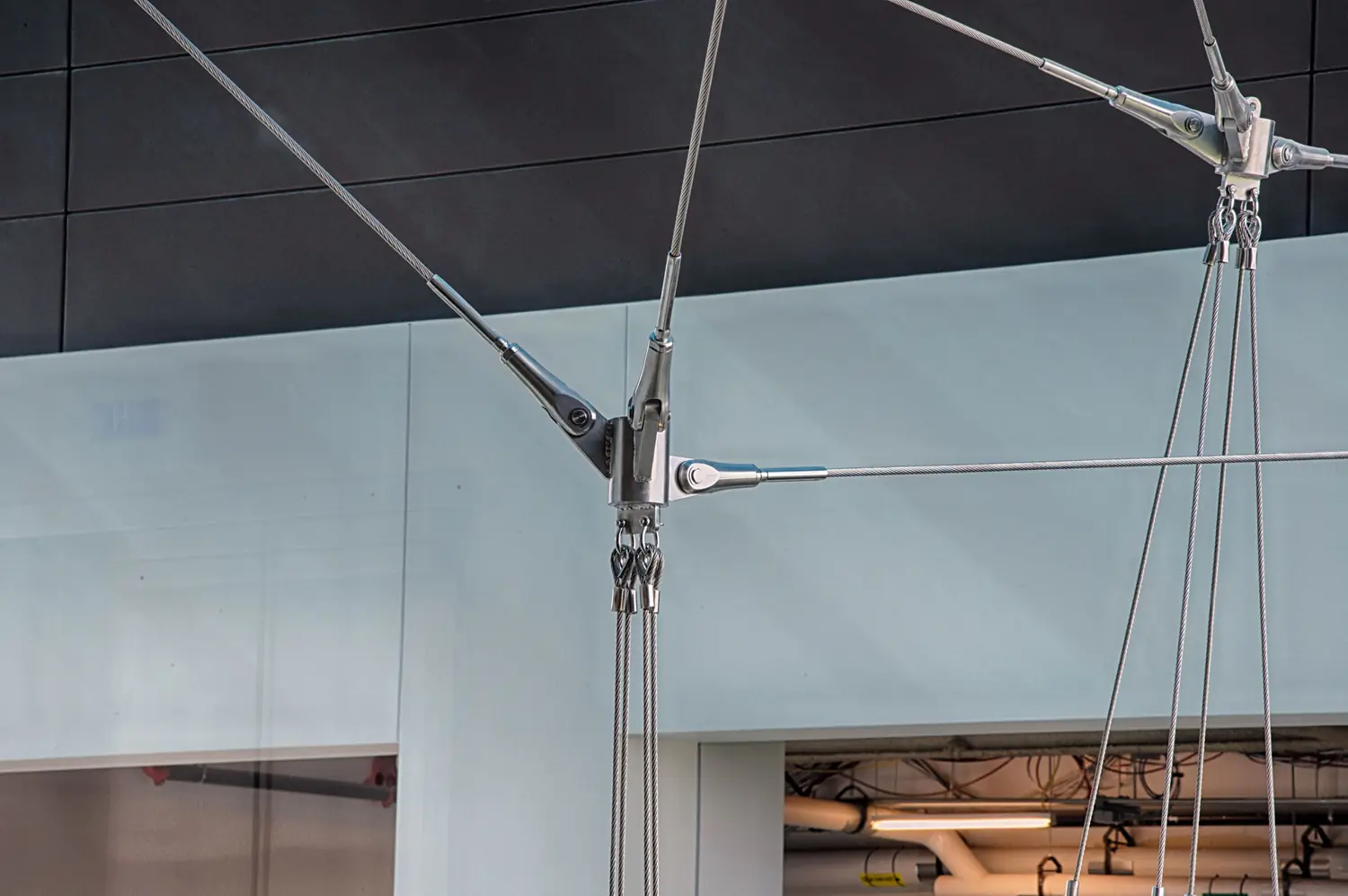

ProjectsBuilt by Acier
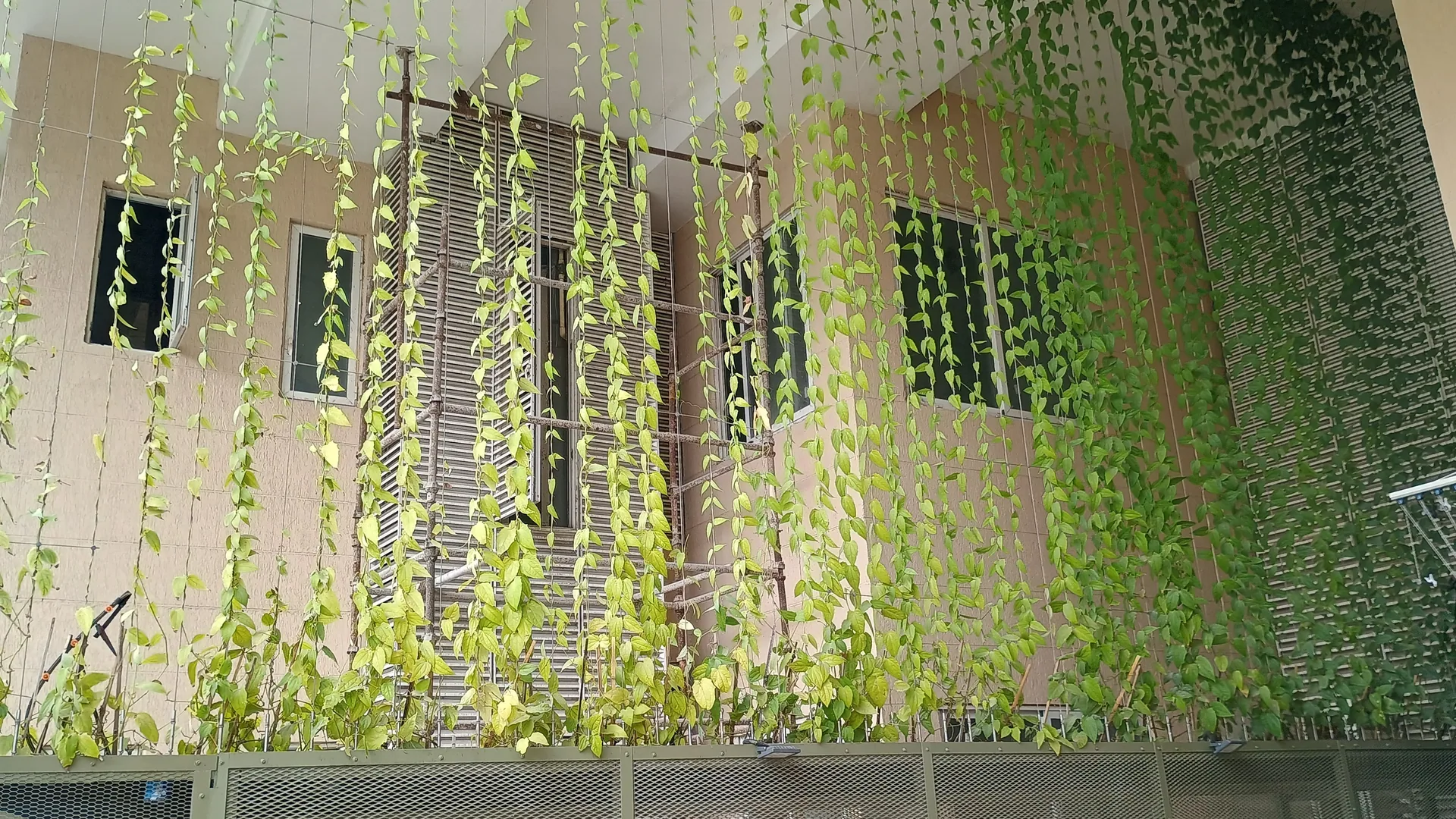
Green privacy wall, Lower Parel
A green privacy wall, 7 m high and 9 m long, on a high-rise duplex deck in Lower Parel, Mumbai: climbers on a grid of Ø4 mm Jakob ropes in a welded MS frame.
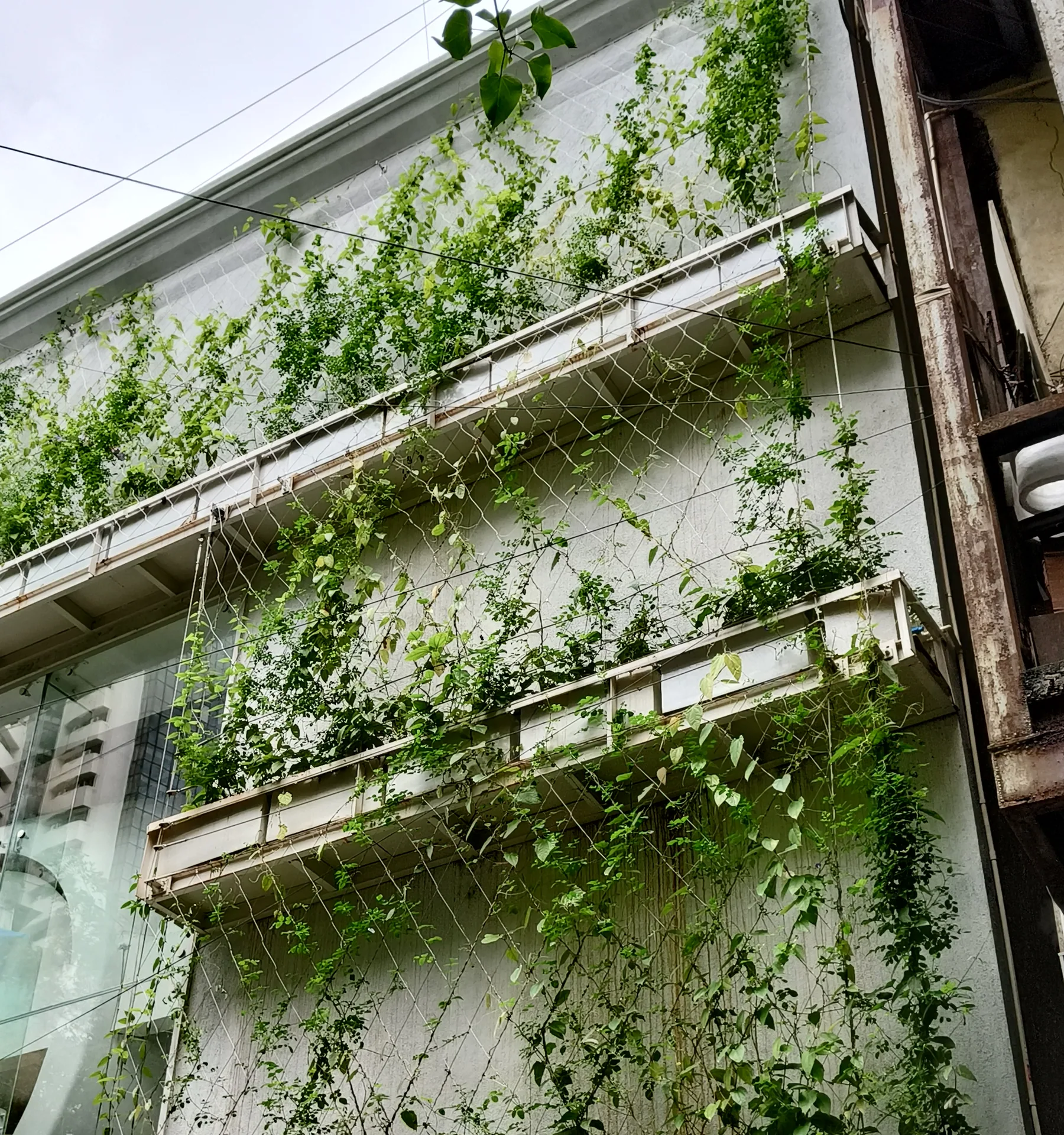
Façade planters, Kala Ghoda
Planter troughs, Jakob ropes and Webnet bring planting to a shopfront building in Kala Ghoda, Mumbai's heritage district.
DownloadsCatalogues and drawings
QuestionsFrequently asked
How long until the wall is green?
With fast climbers such as Bengal clock vine or Rangoon creeper, planters every floor (or ground beds), drip irrigation and planting before the monsoon, most walls look dense in 12 to 18 months.
How far apart should planter levels be?
Every floor (about 3.2 m) gives the fastest, densest result. Every two floors works with vigorous climbers and bigger planters. Ground beds alone suit walls up to 3 or 4 floors.
How big should a planter be?
Plan about 40 to 60 litres of growing mix per m² of wall a planter has to cover, and at least 400 mm deep for vigorous climbers.
Do you maintain the plants?
Yes. We offer maintenance contracts covering pruning, training, feeding, irrigation checks and pest control.
Read moreGuides
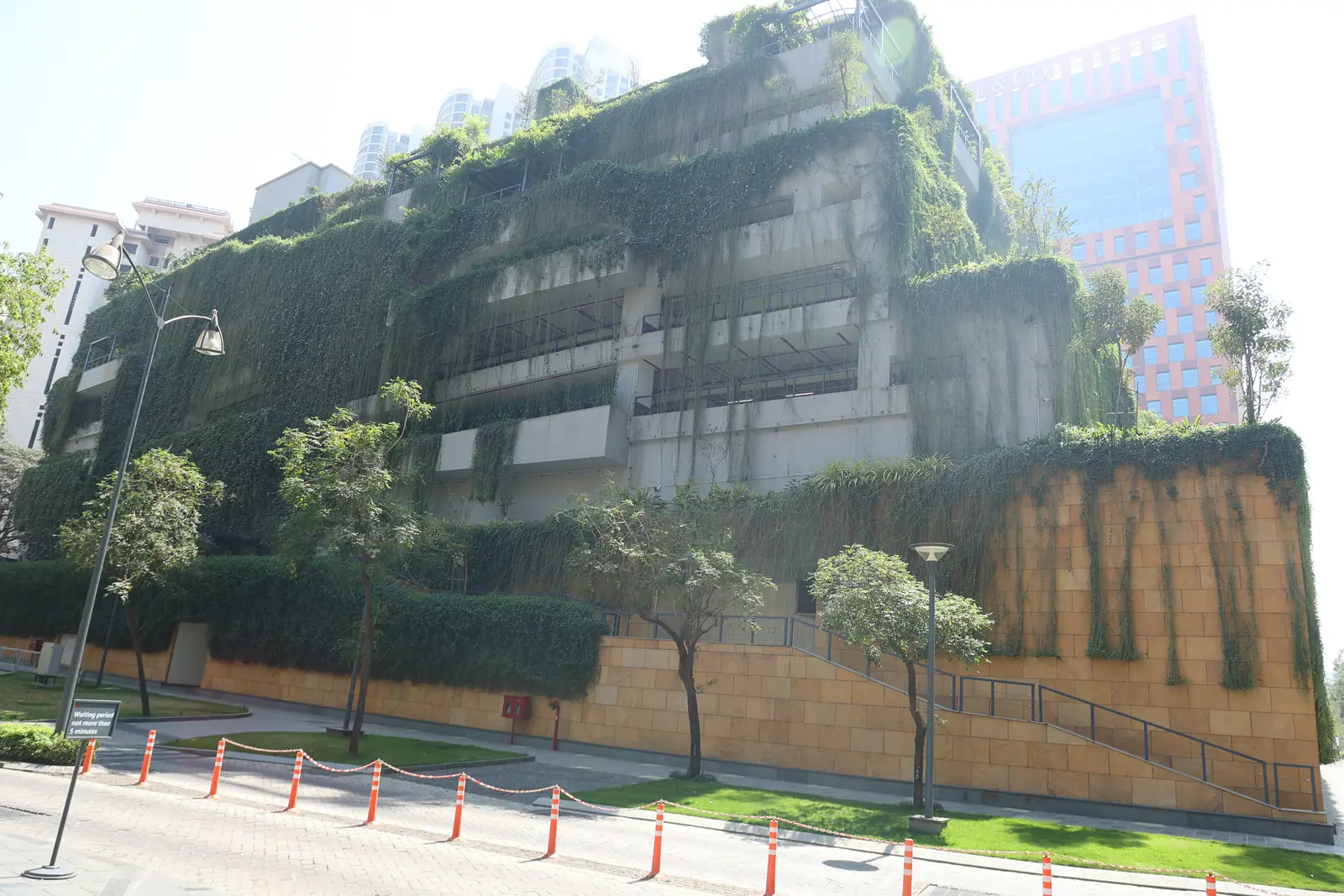
Green façades explained: cables, Webnet or trellis?
The three main ways to support climbing plants on a building, and how to match each one to the plants, the wall and the look you want.
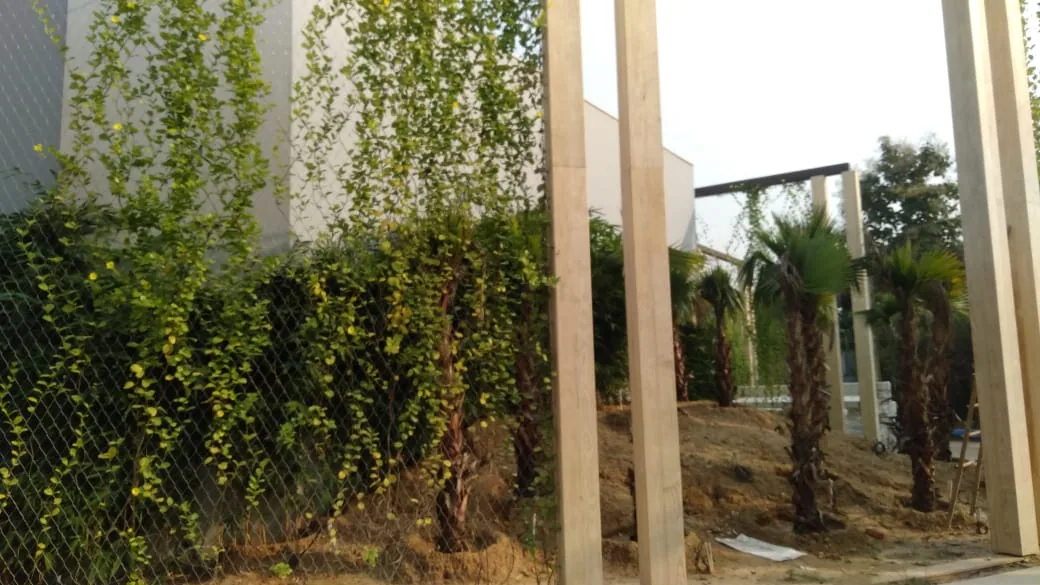
Will climbing plants burn on stainless steel ropes or mesh?
The question we are asked most about green façades in India. The short answer is no. Here is why, and what really stresses plants in the heat.