
In this section ▾
Greening
- Green façade, Nirlon Knowledge Park
- Green façades, FLAMES University
- Green-canopy pergola, Godrej Properties
- Webnet green canopy, private farmhouse, Delhi
- Green privacy wall, Lower Parel
- Façade planters, Kala Ghoda
Railings
- Walkway bridge, Panjim
- Webnet railings, Third Space, Udaipur
- Vertical cable railing, private residence, Delhi
- Cable railings, Panchshil YOO Villas, Pune
- Cable railing, private villa, Jhansi
- Webnet terrace railing, private residence, Udaipur
Safety
- Perimeter fencing, Embassy, Delhi
- Helipad safety net, AIIMS New Delhi
- Helipad safety net, Bengaluru
- Stair tower safety nets, Third Space, Udaipur
- Mesh balcony, Mumbai
Enclosures
All projects →Leopard enclosure, Mumbai Zoo
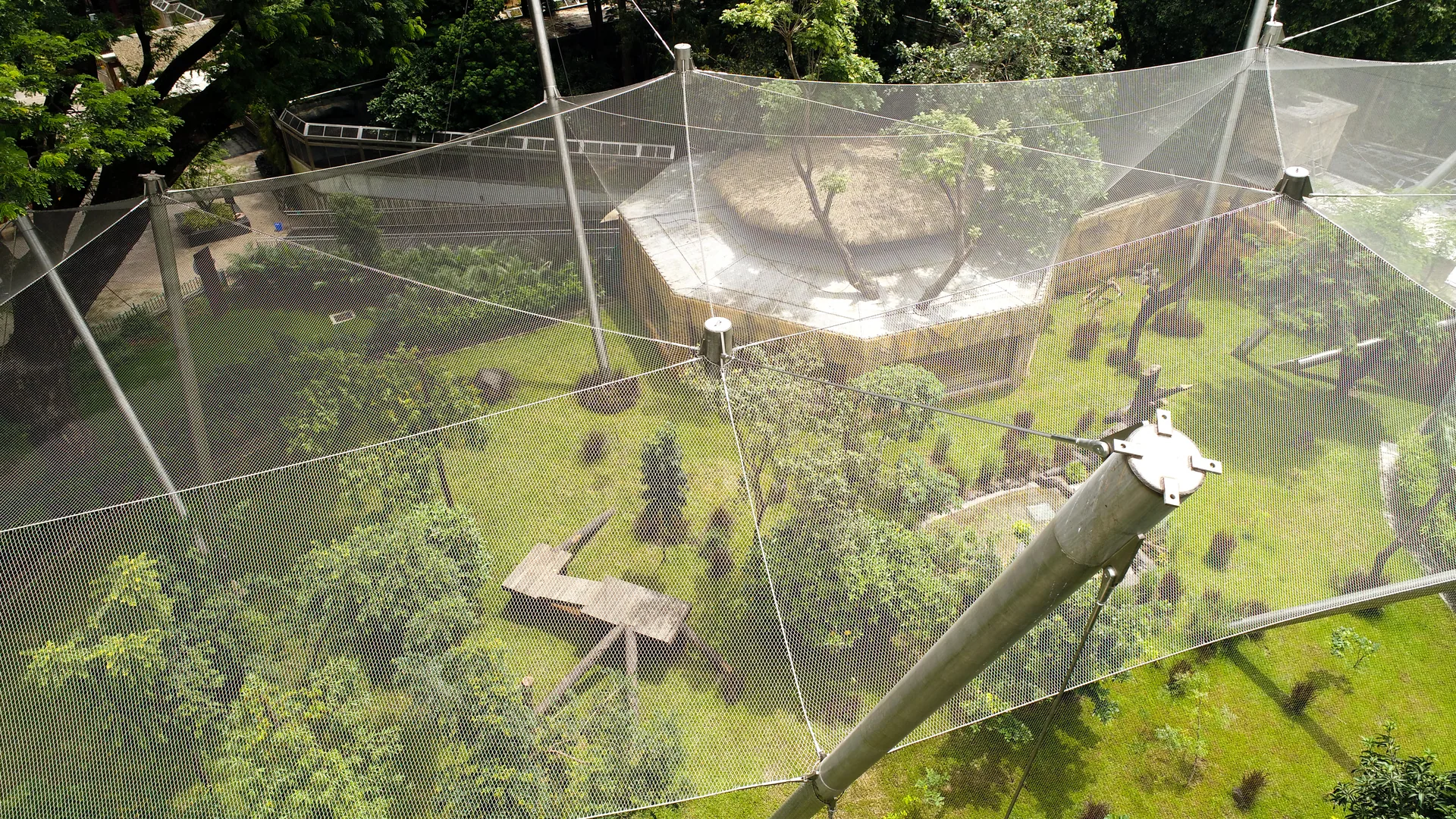
A leopard habitat at Mumbai Zoo under a single tensioned Webnet canopy: 1,175 m² at an average height of 12 m, the first leopard enclosure in India under a rope and mesh canopy.
01The brief
Veermata Jijabai Bhosale Udyan, Mumbai's zoo at Byculla, planned a new habitat for its leopards. The whole animal enclosure was to sit under a single tensioned Webnet canopy: 1,175 m² in plan, with an average height of 12 m, built around the trees already on the site, with HKS Designer & Consultant as architect. Acier took on design, engineering, supply and installation, as one point of responsibility for the complete canopy. It became the first leopard enclosure in India under a tensioned rope and mesh canopy.
02The challenge
A canopy of this size has several jobs to do at once. It must safely contain a large cat that climbs and jumps. It must carry its own weight and wind loads across long spans, and stay light enough that the habitat does not feel closed in. The site added its own difficulties. Mature trees stood inside the footprint and had to be kept, cranes had little room to reach the pylons, and a tensile structure only finds its shape once every rope is in place and loaded.
03The solution
Acier engineered the canopy as a tensioned rope structure. Steel pylons, some of them inclined, carry the primary stainless ropes: 30 ropes of Ø22 mm and 21 of Ø26 mm. These ropes take the main loads and set the shape of the roof. While the pylons went up, the team held them in position with temporary dummy ropes until the final ropes could be fitted and tensioned.
The mesh is Jakob Webnet in Ø2 mm stainless rope with a 50 mm mesh width, strong enough to hold a leopard yet light against the sky. It arrived in large, heavy panels, 2,132.76 m² in all, which were laced into place at height from boom lifts and by rope access. Where branches crossed the canopy line, the mesh was cut and laced around them so the trees could stay. The work took 10 to 12 weeks on site.
AnatomyHow the pieces fit together
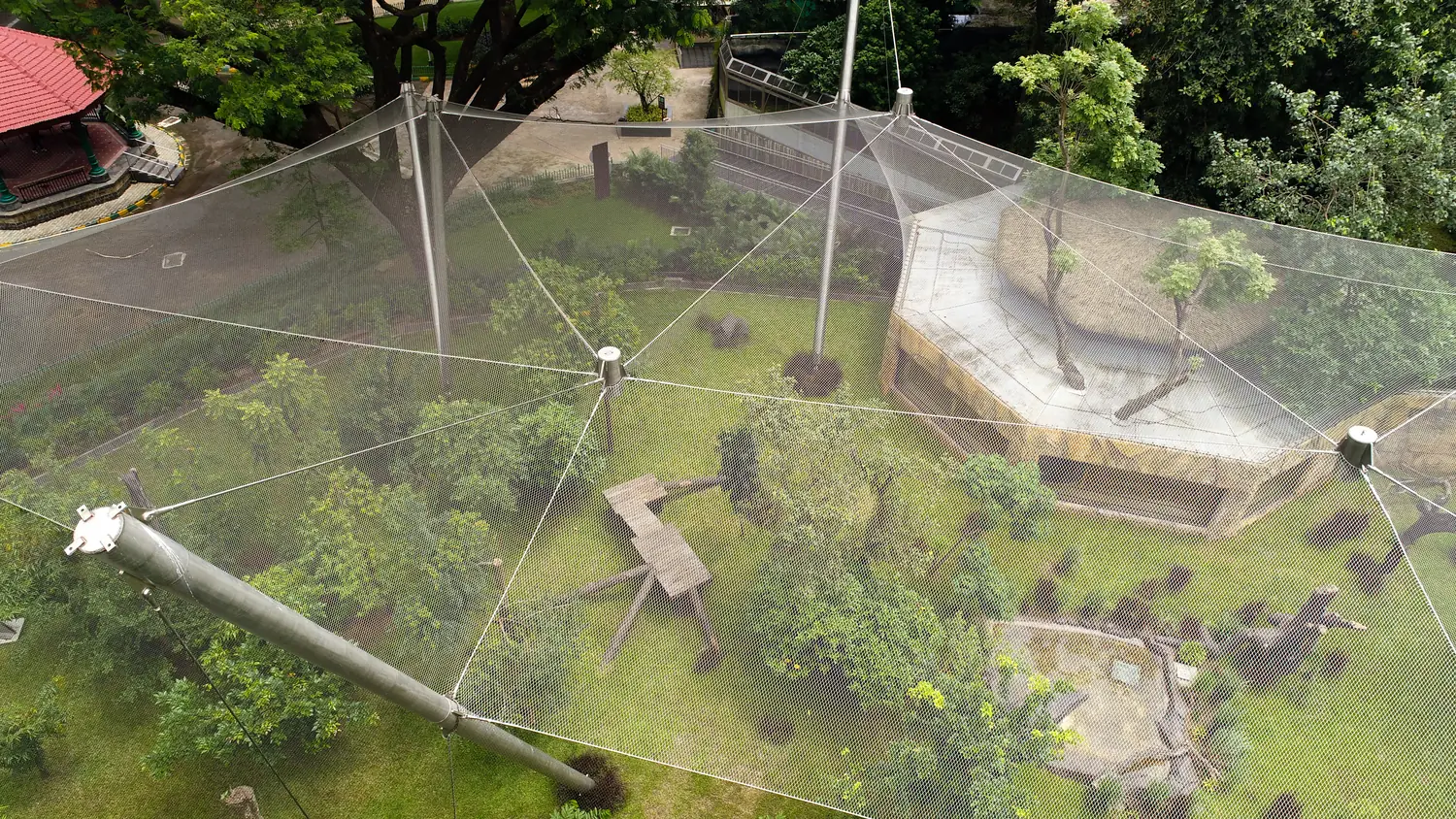 1234
- Mast headPrimary ropes Ø22 and 26 mm meet at the mast
- Webnet Ø2 mm · W 50 mm2,132.76 m² of mesh
- Inclined mastKeeps the habitat clear of structure
- The habitat1,175 m² covered
SpecificationProducts used
PhotosGallery
04The outcome
The leopards now live under a canopy that covers 1,175 m² at an average height of 12 m, with the zoo's trees growing through it and clear views in from outside. The enclosure was completed in 2020, the first of its kind in India. The zoo's walk-through bird aviary, also from 2020, uses the same mesh system at a finer size.